Nexqario
Halo Map
Halo Map
Couldn't load pickup availability
1. Problem Statement
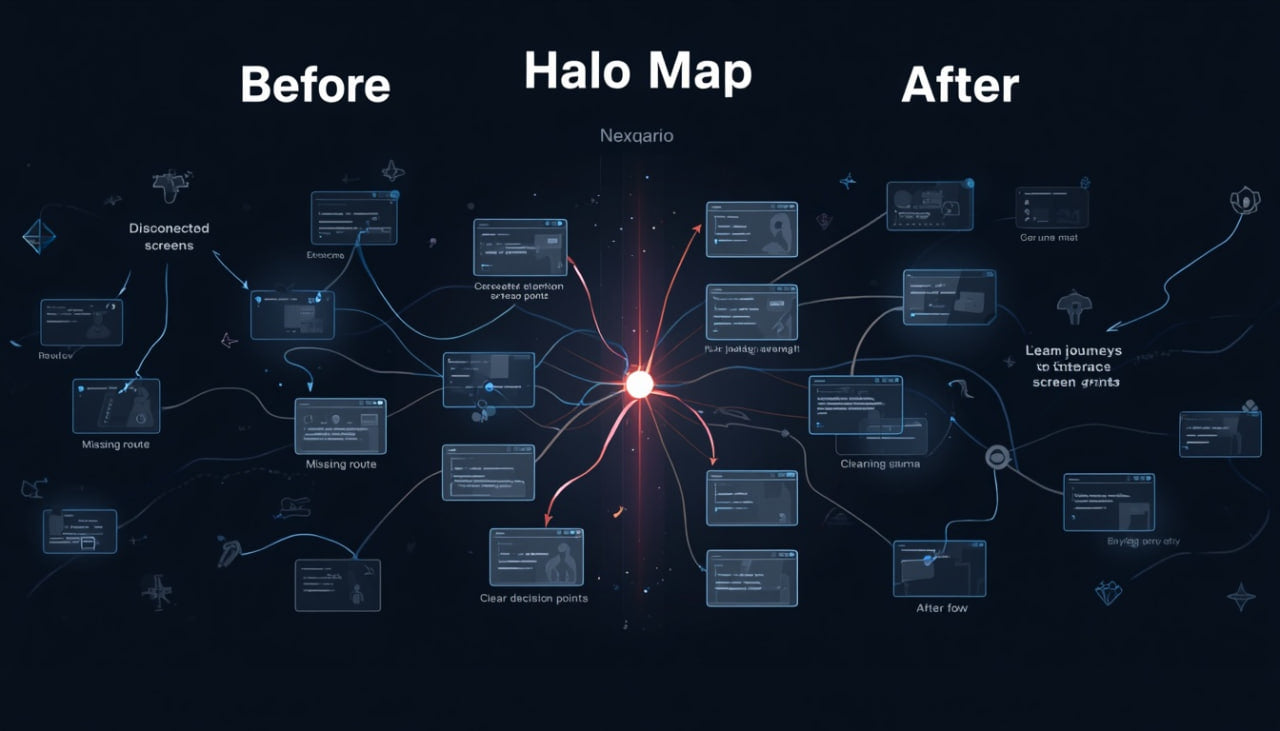
Many UI/UX learners can study a single screen, but they often find it harder to understand how several screens work together. A layout may look organized on its own, yet the journey can still feel unclear when the next step, previous step, or surrounding context is weak. Learners may also struggle to map what a person should see, read, decide, and do across a sequence. Without a route-based study method, interface work can become fragmented and difficult to explain. Halo Map was created to help learners study design as a connected path rather than a set of separate screens.
2. Solution
Halo Map introduces a structured way to study user journeys, screen order, content placement, and decision points. The course materials guide learners through mapping exercises that show how one screen leads into another and how each moment should carry useful context. Learners practice writing journey notes, organizing screen states, and identifying moments where a person may need guidance. The tier also shows how content and layout can work together to reduce confusion across a digital flow. This gives learners a stronger method for planning UI/UX ideas before moving into detailed screen design.
3. What’s Inside
Halo Map includes a detailed collection of UI/UX course materials focused on journey thinking and screen-to-screen structure. The tier begins with an orientation section that explains why mapping matters in UI/UX. Learners are introduced to the idea that a digital experience is not only about how a screen looks, but also about how a person arrives there, what they understand there, and where they go afterward.
The opening module focuses on journey basics. Learners study simple digital routes such as browsing a course category, opening a course page, reading key details, submitting a question, or moving through an onboarding-style sequence. The materials explain how each step in a journey should have a role. A screen might introduce an idea, confirm a choice, collect information, show progress, or guide the learner toward another section. By naming the role of each screen, learners can start to understand the flow as a connected structure.
The second module introduces route mapping. Learners are guided through exercises where they create simple maps using screen names, user actions, content notes, and decision points. This module does not require complex visual diagrams. Instead, it focuses on plain, readable mapping that helps learners understand direction and purpose. Learners practice writing notes such as “the user compares options,” “the user reads the course summary,” or “the user needs confirmation before moving onward.” These notes help make invisible interaction logic easier to study.
The third module focuses on decision points. Every user journey includes moments where a person decides what to do next. Learners study how buttons, links, forms, summaries, and supporting text can shape those moments. The materials ask learners to identify where a person might pause, where additional context may help, and where wording may need to be clearer. This section helps learners see how small interface choices can affect the larger journey.
The fourth module explores screen states. Learners study how a design may change depending on what the person has done or what information is being shown. Examples include empty states, filled forms, confirmation states, error states, saved items, course progress views, or message states. The focus is on understanding how UI/UX design should account for different moments in the same journey. Learners practice writing state notes that describe what the person sees, what the screen communicates, and what action may come next.
The fifth module focuses on content routes. A user journey is not only a movement between screens; it is also a movement through information. Learners study how headings, descriptions, short lists, course details, and help text can be arranged across a flow. The materials show how repeated information can create clutter, while missing context can create friction. Learners practice deciding which information belongs at the start of a flow, which belongs near a choice, and which belongs after a user action.
The sixth module introduces journey friction review. Learners receive prompts for finding weak spots in a route, such as unclear next steps, repeated actions, missing confirmation, crowded sections, or labels that do not match user expectations. The goal is to develop a practical way to identify friction without relying on vague opinions. Learners are encouraged to describe what may slow down understanding and how the journey could be adjusted with cleaner structure.
The seventh module brings the tier together through a guided mapping project. Learners work through a sample course discovery journey from the first page view to a final support or checkout-related step. They define the journey goal, list the screens, map the user actions, mark decision points, add content notes, and write a short improvement plan. This exercise helps learners connect all parts of the tier into one reusable study method.
Halo Map also includes worksheets for journey notes, route mapping, screen states, content placement, and friction review. These worksheets are designed to keep design thinking organized while learners explore larger UI/UX flows. Each worksheet uses focused prompts so learners can study journeys without becoming lost in too many details at once.
The closing section invites learners to compare a single-screen view with a journey-based view. This helps them notice how UI/UX decisions change when the experience is studied as a sequence. By the end of the tier, learners have a stronger way to think about movement, context, and structure across multiple screens.
4. Who Is This For?
Halo Map is for learners who want to move beyond single-screen analysis and study how full digital journeys are arranged. It is suited for people who already understand basic layout, hierarchy, and interface observation, and now want to explore flow planning in greater depth.
This tier may fit learners who enjoy maps, structure, user paths, and organized thinking. It is also useful for those who want to study course pages, onboarding flows, form sequences, learning dashboards, and support journeys. These experiences often depend on clear movement from one step to another, so a mapping-focused method can make the study process easier to follow.
Halo Map is also helpful for learners who want to explain design ideas with better structure. Instead of only saying that a page feels confusing, learners can point to the exact part of the journey where context, content, or direction may need work. This makes their design notes more practical and easier to revise.
5. What You’ll Learn
- How to study UI/UX as a connected journey
- How to name the role of each screen in a digital flow
- How to create simple route maps using screen names and action notes
- How to identify user decision points across a journey
- How to plan screen states such as empty, filled, confirmation, and error states
- How to organize content across several steps
- How to reduce repeated information in a flow
- How to notice missing context before a user action
- How to write journey notes that explain movement and purpose
- How to review friction across screen sequences
- How to connect layout choices with user movement
- How to build a journey-based UI/UX study routine
6. 30-Day Refund Note
For Halo Map, Nexqario may offer a 30-day refund window according to the store policy shown during checkout and on the refund policy page. Refund requests are handled through the store support channel and may depend on order status, material delivery conditions, and the terms listed for this course tier. Learners should read the policy details before ordering and contact the Nexqario team with any questions about the course materials or refund process.
Self-paced learning overview
- 📁 Digital file available after purchase
- 🗂️ Long-term availability
- 🔒 Secure checkout
- 🧩 Content updated in 2026
Do I need previous UI/UX knowledge?
Do I need previous UI/UX knowledge?
No previous UI/UX background is required for the beginner-friendly tiers. Each tier is arranged with a clear learning order, so learners can study the material at a comfortable pace and return to key ideas when needed.
What do the course materials include?
What do the course materials include?
Depending on the tier, the materials may include lessons, modules, design prompts, worksheets, layout references, research notes, interface exercises, and guided study tasks. Each tier is shaped around a different depth of learning.
How should I choose a tier?
How should I choose a tier?
Choose a tier based on how deeply you want to study UI/UX at this stage. Free Capsule is a light starting point, while higher tiers move into broader topics, richer materials, and more detailed learning paths.
Share