Nexqario
Loom Session
Loom Session
Couldn't load pickup availability
1. Problem Statement
Many learners reach a point where they can study screens, map journeys, and describe interface patterns, but they still need a stronger routine for reviewing and improving their own design ideas. It can be difficult to know when a layout needs more structure, when content needs editing, or when a user flow needs a different order. Learners may also collect many observations but struggle to turn them into a practical revision plan. Without a steady review rhythm, design work can feel unfinished or scattered. Loom Session was created to help learners bring their UI/UX notes, sketches, and decisions into one organized learning process.
2. Solution
Loom Session gives learners a guided method for studying UI/UX through repeated review sessions. The course materials help learners examine a design idea from several angles: user intent, content structure, visual hierarchy, screen flow, and friction points. Instead of treating revision as a final correction, this tier presents revision as a normal part of the design process. Learners work through focused session prompts that help them question, adjust, and document their choices. This creates a calmer path for turning early design ideas into more thoughtful interface studies.
3. What’s Inside
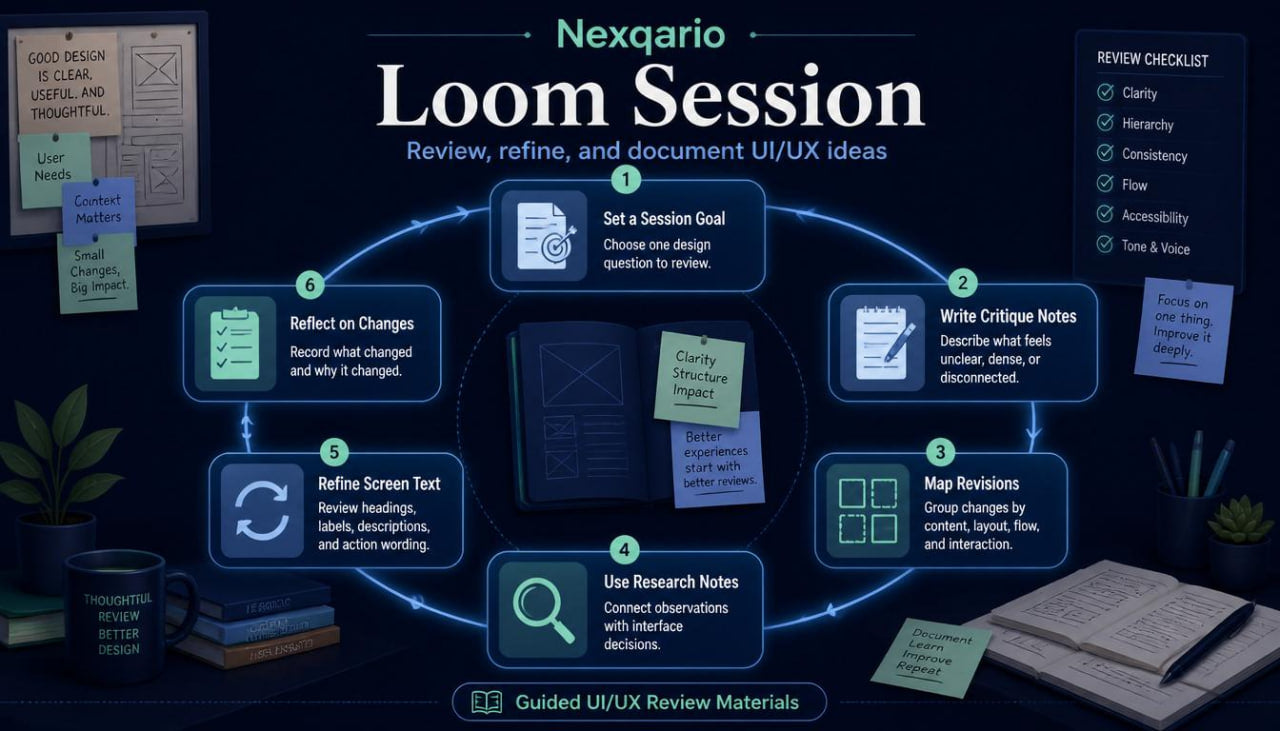
Loom Session includes a structured collection of UI/UX course materials built around guided review and revision. The tier begins with an orientation section that explains how to use design sessions as a learning method. A session is presented as a focused block of study where learners review one interface idea, one flow, or one design question at a time. This helps learners avoid jumping between too many topics and gives their practice a more organized shape.
The first module focuses on session planning. Learners study how to define a session goal before reviewing a layout or flow. The materials guide them to write short prompts such as “review the page structure,” “study the form flow,” “compare section order,” or “check whether the content gives enough context.” These prompts help learners enter each review with a purpose instead of looking at a screen without direction.
The second module explores design critique language. Learners study how to write notes that are specific, calm, and useful. Instead of using vague reactions, they learn to describe what may be unclear, what feels too dense, which section needs better grouping, or where a user may need additional context. This module helps learners separate personal taste from design reasoning. It also encourages a more thoughtful tone when reviewing their own work or sample materials.
The third module focuses on revision mapping. Learners practice turning critique notes into a simple revision plan. The materials show how to group changes by category, such as content, layout, flow, interaction, or visual rhythm. This helps learners avoid changing everything at once. They learn to identify which adjustments belong together and which should be reviewed separately.
The fourth module introduces research note weaving. Learners study how research observations can influence layout and content decisions. This section does not require complex research methods. Instead, it focuses on simple observations: what users may look for, what they may misunderstand, what information they may compare, and what context may help them continue. Learners practice connecting these notes to actual interface decisions.
The fifth module focuses on content refinement. Learners study how to revise headings, descriptions, labels, section text, form hints, and action wording. The materials show how wording can shape the way a person understands a screen. Learners practice making content shorter, more direct, and more aligned with the purpose of each section. The goal is to improve readability while keeping the design voice natural.
The sixth module explores visual rhythm. Learners study how spacing, section order, repeated patterns, and layout balance affect the reading experience. They review examples where content feels too compressed, too disconnected, or uneven across the page. The exercises ask learners to adjust grouping, spacing logic, and section rhythm before adding decorative choices. This helps them focus on structure first.
The seventh module brings the course tier together through a guided review session. Learners choose a simple interface concept, prepare a session goal, review the layout, write critique notes, map revisions, connect research observations, refine content, and write a short reflection. This creates a complete practice loop that can be repeated with different UI/UX exercises.
Loom Session also includes worksheets for session planning, critique notes, revision mapping, content review, research observations, and final reflection. These worksheets are designed to help learners keep each review focused and documented. The materials can be used while studying examples, refining course exercises, or organizing personal design practice.
The closing section encourages learners to build a repeatable study rhythm. They are guided to review what they changed, why they changed it, and what design question they want to examine in a later session. This helps learners treat UI/UX study as an ongoing practice of observation, reasoning, and careful revision.
4. Who Is This For?
Loom Session is for learners who want to bring more order to their UI/UX practice. It is suited for people who have studied layout, journey mapping, and interface patterns, and now want a stronger way to review and revise design ideas.
This tier may fit learners who enjoy written notes, guided critique, and structured practice sessions. It can also be useful for people who often start design exercises but feel unsure how to review them afterward. Loom Session gives them a method for slowing down, asking better questions, and organizing revision work.
It is also helpful for learners who want to connect research observations with design decisions. Instead of keeping research notes separate from interface planning, learners study how observations can shape content order, user flow, and layout choices. This makes the course tier useful for deeper UI/UX study without relying on exaggerated claims.
5. What You’ll Learn
- How to plan a focused UI/UX review session
- How to define a design question before reviewing a layout
- How to write critique notes with more care and detail
- How to separate personal taste from design reasoning
- How to organize revision notes by content, layout, flow, and interaction
- How to connect research observations with interface decisions
- How to review headings, labels, descriptions, and action wording
- How to improve content structure without making the page feel heavy
- How to study spacing, grouping, and visual rhythm
- How to review a design idea through a repeatable practice loop
- How to document what changed and why it changed
- How to use worksheets for session planning, critique, and reflection
6. 30-Day Refund Terms
For Loom Session, Nexqario may provide a 30-day refund window according to the store terms shown during checkout and on the refund policy page. Refund requests are reviewed through the support channel and may depend on order status, material delivery conditions, and the terms connected to this course tier. Learners should review the policy details before ordering and contact the Nexqario team with any questions about the course materials or refund process.
Self-paced learning overview
- 📁 Digital file available after purchase
- 🗂️ Long-term availability
- 🔒 Secure checkout
- 🧩 Content updated in 2026
Do I need previous UI/UX knowledge?
Do I need previous UI/UX knowledge?
No previous UI/UX background is required for the beginner-friendly tiers. Each tier is arranged with a clear learning order, so learners can study the material at a comfortable pace and return to key ideas when needed.
What do the course materials include?
What do the course materials include?
Depending on the tier, the materials may include lessons, modules, design prompts, worksheets, layout references, research notes, interface exercises, and guided study tasks. Each tier is shaped around a different depth of learning.
How should I choose a tier?
How should I choose a tier?
Choose a tier based on how deeply you want to study UI/UX at this stage. Free Capsule is a light starting point, while higher tiers move into broader topics, richer materials, and more detailed learning paths.
Share